Monday, February 24, 2014

You talkin' to me?

Before being in the ITS program, the concept of podcasts were very foreign to me.  Sure, the term is one that has slowly made a name for itself in our culture, but I never fully understood what a podcast truly was.  After some investigation, I discovered that podcasts used to be referred to as "audioblogging." That makes absolute sense to me, especially after learning about blogs and their uses.   But, what I still wanted to figure out was why the concept of a PODcast.  Cast makes sense... like a newscast or a broadcast, but pod? My common sense tells me that Apple may have something to do with it. Seems very interesting to me that an entire concept of technology has been taken over by a company such as Apple, but since so many people began to listen to these RSS feeds on iPods, the language shifted to begin calling them podcasts.

Podcasts are everywhere on the internet.  If you google podcasts, there are about 66,700,000 results. Imagine once you link to all of those sites how many podcasts you could actually access! Just navigating through, I found some really neat podcasts from NPR and am afraid I could spend hours just basking in the glory of all those words.  What's so neat about podcasts is that you can search for anything and find an audioblog that doesn't take more than 15 minutes (on average) to listen to! Some are even less than 5 minutes- perfect time for a class or even just a busy teacher.


When I first began searching for podcasts, I felt a little lost.  The more I meandered, though, I realized it really wasn't that much harder than a google search and being more exact in my search. I figured out it was pretty easy to find free podcasts through iTunes.  So often, I hear podcasts advertised in different realms.  My church even publishes sermons on their website, clearly easily accessible. 

Here's my struggle, though. I see the freedom of podcasts and I understand their benefits, but how do I implement podcasts effectively in my classroom? The learning curve that it will take for me to teach my students how to draft a script, record, and publish a podcast could potentially take weeks. It will take even longer to just get in to a computer lab during testing "season"! When we worked on podcasts with our groups in the ITs cohort, even that was a learning curve. I'm imagining 30 9th grade students clustered around me trying to figure it out....and my brain officially feels like it will explode. 


What if, however, students already knew how to create podcasts and I could implement them seamlessly into my lesson? Or why not use the benefit of Audacity, that many students already use in their foreign language classes, and take it just a step further? I need to remember, too, that these kids are netgenners and the time it will take to teach them anything this "technologically advanced" really won't be that difficult.  The challenge now...what should my students create podcasts about that would really supplement my curriculum? 


Wednesday, February 19, 2014

Wiki-who? Wikis work!

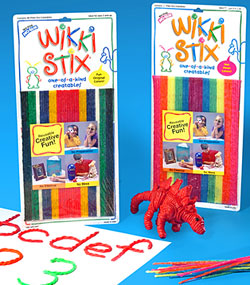
The world of wikis used to be such an abstract concept to me.  When I heard wiki, inevitably I would think of Wikki Stix that I used to play with when I was little.


Does anyone remember these? Of course, that is not at all what wikis are... but a few months ago, ask me and that's what I would have gushed about on the subject of this sticky web of creativity.

Of course I had been exposed to the now infamous Wikipedia, but if I had to define what a wiki was, well forget it.  After going through the ITS program and discussing the benefits of Wikipedia, it has completely changed my perspective.  In the past, if students asked if they could use Wikipedia for sources or for a reference, I would respond with a head shake, eye roll, and absolutely not- it isn't a reliable source.  Boy, was I ever wrong.  When Dawn told us that Wikipedia actually employed fact checkers and their sites could certainly be used as resources, I realized I needed to change my stuck in the mud way of thinking.

The world of wikis, a world set in web 2.0 and set up as a collaborative site, may be fairly new to the field of education.  The more I learn, however, the more I realize that wikis are an excellent tool to use in the classroom.  As an English teacher, I do recognize that there would be limitations for creating a wiki that was really the most appropriate affordance could get dicey.  Although, as I consider the possibilities for implementation, my mind reels with the various ways I could introduce wikis in the classroom.


In an ideal world, I could introduce a lesson on grammar, literary terms, or plot details and allow my students to collaborate and contribute their knowledge base.  I really like how we, as ITSers, have been working together to complete the ITSOPEDIA pages and implement our skill sets.  The same format could easily take place in my classroom.  Additionally, as students add facts, edit details, and improve the elaboration, they could also add connections to the literary works we read in class.  Essentially, the wiki could be a asynchronous tool that the students complete to build so many literary skills.


As a designer, I have struggled with ways to accurately assess students in order to provide meaningful feedback.  My school has worked with the implementation of formative and summative assessments and the world of wikis only adds another perspective to the conversation.  Wikis would be an excellent tool to support any unit plan that students would need numerous formative assessments to prepare them for their summative assessment.  Novels, for example, have so many layers of intricacy and creating small groups who are responsible for different skills sets within the unit would be such a different way to approach the material.  Wikis allow the educational world to transcend the classroom and bring students fully into web 2.0.


Monday, February 10, 2014

Let's give 'em somethin' to talk about...

So often I watch my students engage in hearty conversations and sit back and smile at their ability to discuss so freely. Of course, sometimes these conversations aren't the discussions I foresee coming, but I am continually impressed with the depth of their contributions. Just today, I started a lesson with my students as in introduction to the play Twelve Angry Men.


The students haven't been told yet that we are moving forward to begin the play, but instead I introduced the concept of bias to them. After taking time to look at images and being told to note their observations, we led quickly into how our biases impact all of our viewpoints. Students very quickly chimed in and enthusiastically voiced their opinions on how our biases are developed. I was thrilled at their observations, but at the same time saddened that I was the only one being able to hear their highly intelligent perspectives.

Thinking about it now, it would be such a great opportunity to have my students continue their thoughts after a lesson has "ended." I know that after I leave class, my brain is still reeling with ideas and I would love to imagine that my students have the same experience. Class today ended in perfect timing with the bell ringing as soon as I posed a very deep concept to my students.  I saw in so many of their eyes that there was a genuine A-HA moment happening. I was giddy with excitement and cannot wait to see them again to hear their reactions.


But what if I didn't have to wait? What if I created a blog that was a venue for my classes to continue the discussion well after we left the school building? My students and parents have shared that conversations that stem from class discussion are happening around the dinner table, but I am not privy to the continued banter. If I had a blog that allowed for an open forum of discussion, I would be able to hear all the thoughts that are now just getting lost in their teenage brains.


Maybe I don't quite yet know what form a blog such as this would look like, but I do know that so often my students are leaving me with excellent concepts mulling around in their brains and I never get to salvage those musings. In Richardson's Blogs, WIkis, Podcasts, and Other Powerful Web Tools for Classrooms, he makes the point that blogs act as ". . . an audience for . . . ideas." In classes of 30 students, it is rare for me to hear every opinion of every student.  If, however, students were able to leave class and continue their conversation in individual blogs, I would become their audience. 

Obviously, Richardson does discuss the need to scaffold the implementation of blogging, but the ideal would be students independently blogging. Initially, I could take baby steps and work my students into the concept. If I started a blog for my classes, I could require each student to respond a certain number of times or even to a certain prompt.  A prompt could be as simple as, What did you think about after the bell rang today? 


While a discussion based blog is certainly plausible for my classroom, Richardson's notion that students ". . . could be asked to reflect and build on previous ideas, incorporate feedback from readers, synthesize readings from a number of different sources, and advances new ideas or interpretation of the topic" is intriguing. If students were able to reflect in such an open forum, imagine the possibilities of the discussion. My giddiness as the bell rang today doesn't have to suspend mid-air and slowly dissipate as the hours tick on until I have to wait to see my students again. No- my giddiness could continue as I read all of the detailed discussion points my students blogged about into the night. Not only that, but I could sit and marvel as my students comment on each others' blogs. Even better, I could be thrilled to see that my students were discussing the points we raised in class with other classes! I would not longer have to think silently to myself, "Gee, I wish block __ could have heard that point!" Instead, students would be "hearing" their peers as their blogs flowed with brilliance! Sigh, a girl can only hope. I wholeheartedly agree with Richardson that " . . . Weblogs can play an important role in [my] classroom." 

But the big question is...where to start?